


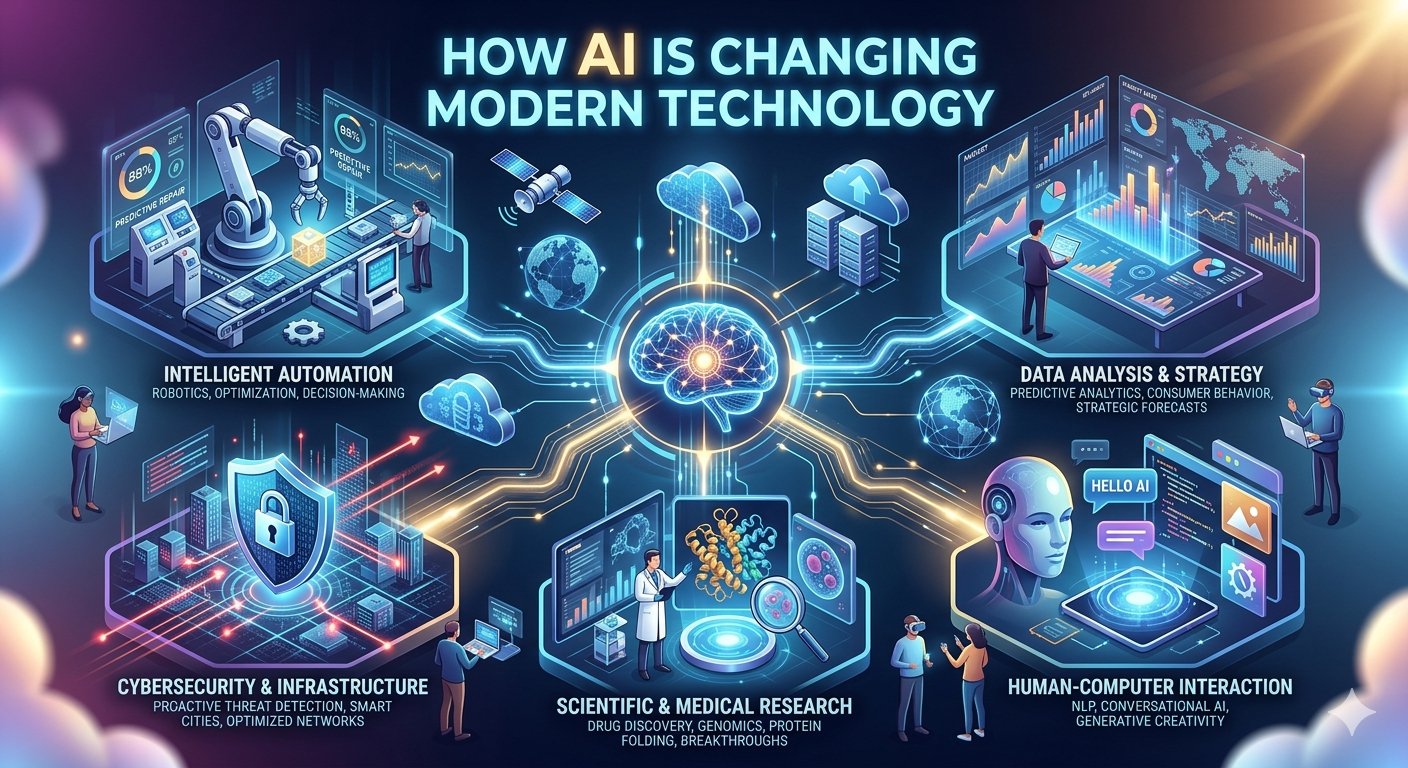
Artificial Intelligence, commonly known as AI, is transforming the world faster than ever before. From smartphones and healthcare systems to online businesses and smart homes, AI is becoming a major part of modern technology. Businesses, governments, and individuals are using AI-powered tools to improve efficiency, automate tasks, and solve complex problems.
Understanding How Artificial Intelligence Is Changing Modern Technology is important because AI now influences almost every industry and aspect of daily life. In 2026, AI is no longer just a futuristic idea. It has become one of the most powerful technologies shaping the modern world.
In this article, you will learn how AI is transforming technology, improving industries, and creating new opportunities for businesses and individuals.
What Is Artificial Intelligence?
Artificial Intelligence refers to computer systems that can perform tasks that normally require human intelligence. These tasks include:
- Learning from data
- Solving problems
- Understanding language
- Recognizing images
- Making decisions
AI systems use machine learning, deep learning, and advanced algorithms to process information and improve performance over time.
Examples of AI technology include:
- Virtual assistants
- Chatbots
- Recommendation systems
- Self-driving cars
- Facial recognition software
AI technology continues to improve rapidly, making it more useful in both personal and professional environments.
AI Is Transforming Business Operations
One of the biggest examples of How Artificial Intelligence Is Changing Modern Technology can be seen in the business world. Companies use AI to automate repetitive tasks, improve customer service, and increase productivity.
Businesses now use AI for:
- Data analysis
- Customer support
- Inventory management
- Marketing automation
- Fraud detection
AI helps companies save time and reduce operational costs. For example, AI-powered chatbots can answer customer questions 24 hours a day without human assistance.
Businesses that adopt AI technology often gain competitive advantages because they can work faster and make smarter decisions.
AI in Healthcare Technology
Healthcare is one of the industries most affected by artificial intelligence. AI tools are helping doctors, hospitals, and researchers improve patient care and medical research.
AI in healthcare is used for:
- Disease detection
- Medical image analysis
- Personalized treatment plans
- Drug development
- Virtual health assistants
AI systems can analyze large amounts of medical data quickly and identify health problems more accurately.
For example, AI can detect certain diseases in medical scans earlier than traditional methods in some cases. This can improve treatment success rates and save lives.
Healthcare technology powered by AI continues to grow in importance around the world.
AI Is Changing Communication Technology
Communication technology has improved significantly because of AI. Modern communication platforms now use artificial intelligence to improve user experience and automate interactions.
Examples include:
- Smart email filtering
- Real-time language translation
- AI chatbots
- Voice recognition systems
- Virtual meeting assistants
AI-powered virtual assistants like voice assistants can answer questions, set reminders, and control smart devices.
Real-time translation tools also make global communication easier by instantly translating conversations and text into different languages.
These technologies help businesses and individuals communicate more efficiently.
AI in Cybersecurity
Cybersecurity has become more important as digital threats continue to increase. AI is helping organizations improve security systems and protect sensitive information.
AI cybersecurity tools can:
- Detect suspicious activity
- Identify cyber threats quickly
- Prevent fraud
- Monitor network security
- Respond to attacks automatically
Traditional cybersecurity systems often struggle to detect new threats quickly. AI systems can analyze patterns and identify unusual behavior faster than humans.
Businesses now rely heavily on AI to protect customer data and online systems.
AI and Smart Devices
Smart devices are another major example of How Artificial Intelligence Is Changing Modern Technology. Many everyday devices now include AI-powered features that improve convenience and efficiency.
Examples of smart devices include:
- Smart speakers
- Smart TVs
- Smart home security systems
- Smart refrigerators
- Wearable fitness trackers
AI allows these devices to learn user behavior and provide personalized experiences.
For example, smart home systems can automatically adjust lighting, temperature, and security settings based on user preferences.
As AI technology improves, smart devices are becoming more advanced and connected.
AI in Transportation Technology
Transportation technology is changing rapidly because of artificial intelligence. AI is helping improve safety, efficiency, and automation in transportation systems.
Examples include:
- Self-driving cars
- Traffic management systems
- Route optimization
- Predictive vehicle maintenance
AI-powered navigation systems can analyze traffic patterns and suggest faster routes in real time.
Self-driving vehicle technology is also advancing quickly, although full automation still faces technical and legal challenges.
Transportation companies use AI to reduce fuel costs, improve delivery efficiency, and enhance safety.
AI in Education Technology
Education technology is becoming more personalized with the help of AI. Schools, universities, and online learning platforms use AI to improve learning experiences.
AI in education helps with:
- Personalized learning plans
- Automated grading
- Virtual tutoring
- Student performance analysis
AI systems can identify student strengths and weaknesses and recommend customized learning materials.
Online learning platforms also use AI to suggest courses and improve user engagement.
This technology makes education more accessible and efficient for students worldwide.
AI and Digital Marketing
Digital marketing has changed significantly because of artificial intelligence. Businesses now use AI tools to analyze customer behavior, automate campaigns, and improve advertising performance.
AI in digital marketing is used for:
- Personalized recommendations
- Chatbots
- Predictive analytics
- Content creation
- Email marketing automation
AI helps marketers understand customer preferences and deliver targeted advertisements more effectively.
Businesses that use AI in marketing can improve customer engagement and increase sales.
AI in Content Creation
Content creation has become faster and more efficient with AI-powered tools. Writers, marketers, and businesses now use AI to generate content ideas, blog posts, videos, and social media captions.
AI tools can assist with:
- Writing articles
- Creating graphics
- Editing videos
- Generating subtitles
- Designing marketing materials
Although AI cannot fully replace human creativity, it helps content creators save time and improve productivity.
This has made content marketing more accessible for small businesses and entrepreneurs.
AI in E-Commerce
E-commerce businesses are using AI to improve customer experiences and increase online sales.
AI-powered e-commerce features include:
- Product recommendations
- Personalized shopping experiences
- Chatbots for customer support
- Inventory forecasting
- Fraud prevention
For example, online stores can recommend products based on customer browsing history and preferences.
This personalization helps businesses improve conversion rates and customer satisfaction.
AI and Automation
Automation is one of the biggest impacts of AI technology. Many repetitive tasks that once required human effort can now be completed automatically.
AI automation is used in:
- Manufacturing
- Customer service
- Accounting
- Logistics
- Data processing
Automation improves efficiency, reduces errors, and saves businesses money.
However, automation also raises concerns about job displacement in certain industries.
Businesses and workers must adapt by learning new skills and working alongside AI systems.
Benefits of Artificial Intelligence
There are many advantages to AI technology in modern society.
Major benefits include:
- Faster decision-making
- Increased efficiency
- Improved accuracy
- Better customer experiences
- Reduced operational costs
- Advanced data analysis
AI helps businesses and organizations solve problems more effectively and improve productivity.
It also creates new opportunities for innovation and economic growth.
Challenges and Risks of AI
Although AI offers many benefits, there are also challenges and concerns associated with its growth.
Some major concerns include:
- Data privacy issues
- Cybersecurity risks
- Job displacement
- Ethical concerns
- Bias in AI systems
Businesses and governments must create responsible AI policies to ensure technology is used safely and fairly.
Human oversight remains important when using AI systems for critical decisions.
The Future of AI in Modern Technology
The future of AI looks extremely promising. Artificial intelligence is expected to become even more integrated into daily life and business operations.
Future AI developments may include:
- More advanced robotics
- Smarter virtual assistants
- Improved healthcare systems
- Fully automated transportation
- Enhanced cybersecurity systems
As AI technology evolves, industries will continue finding new ways to improve efficiency and innovation.
People who learn AI-related skills may benefit from new career opportunities in the growing technology sector.
Conclusion
Understanding How Artificial Intelligence Is Changing Modern Technology is essential in today’s digital world. AI is transforming industries such as healthcare, business, transportation, education, cybersecurity, and digital marketing.
As AI technology continues to grow, its impact on modern life and business will become even more significant in the years ahead